Invictus – SATB a cappella
text: William Ernest Henley
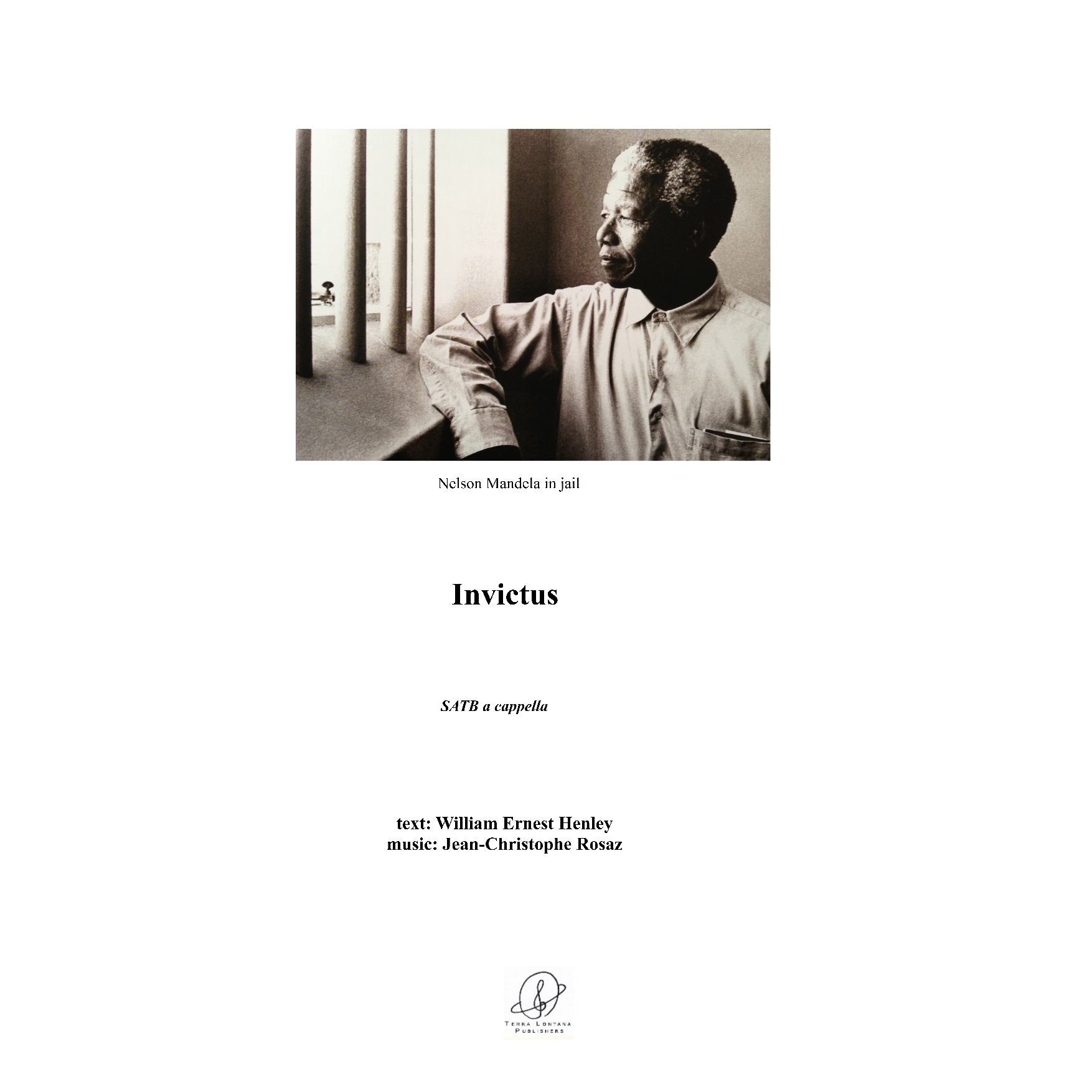
Invictus was Nelson Mandela’s favorite poem. He used to recite and teach it while in prison.
In tribute to all beings imprisoned for unjust reasons.
duration circa 3′
Description
 Télécharger la partition/Download the score
Out of the night that covers me,
Black as the pit from pole to pole,
I thank whatever gods may be
For my unconquerable soul.
In the fell clutch of circumstance
I have not winced nor cried aloud.
Under the bludgeonings of chance
My head is bloody, but unbowed.
Beyond this place of wrath and tears
Looms but the Horror of the shade,
And yet the menace of the years
Finds and shall find me unafraid.
It matters not how strait the gate,
How charged with punishments the scroll,
I am the master of my fate :
I am the captain of my soul.
Sorti de la nuit qui me recouvre,
Noire comme l’abîme d’un pôle à l’autre,
Je remercie les dieux, quels qu’ils soient,
Pour mon âme invincible.
Dans l’étreinte impitoyable du sort,
Je n’ai ni tressailli ni crié.
Sous les coups de massue du hasard,
Ma tête est ensanglantée, mais droite.
Au-delà de ce lieu de colère et de larmes,
Ne se profile que l’Horreur des ténèbres,
Et pourtant, la menace des années
Me trouve et me trouvera sans peur.
Peu importe l’étroitesse de la porte,
La lourdeur des châtiments inscrits,
Je suis le maître de mon destin :
Je suis le capitaine de mon âme.
The Latin title means « unconquered, » « unvanquished, » or « invincible, » and is rooted in the author’s own experience,as the poem was written in 1875 (when William Henley was twenty-five) from his hospital bed following the amputation of his foot. Henley himself described the poem as a testament to his resilience in the face of the pain resulting from the amputation. It was first published in 1888 in a collection of Henley’s work, as part of a series of four poems concerning life and death.Originally, the poem had no title; the title was added by Arthur Quiller-Couch in 1900.
Le titre latin signifie « invaincu, dont on ne triomphe pas, invincible » et se fonde sur la propre expérience de l’auteur
puisque ce poème fut écrit en 1875 (William Henley a vingt-cinq ans) sur son lit d’hôpital, à la suite de son amputation du pied.
William Henley disait lui-même que ce poème était une démonstration de sa résistance à la douleur consécutive à son amputation.
Ce poème est publié pour la première fois en1888 dans un recueil d’Henley, au sein d’une série de quatre textes sur la vie et la mort.
À l’origine, ce poème ne possédait pas de titre, celui-ci fut ajouté par Arthur Quiller-Couch en 1900.
“… A big, radiant fellow, broad-shouldered, with a bushy red beard and a crutch;
jovial, possessed of extraordinary intelligence, and a laugh like a drumroll;
radiating unimaginable vitality and fire, he was captivating.” Lloyd Osbourne
« … Un grand et rayonnant gaillard, large d’épaules, avec une grosse barbe rousse et une béquille ;
jovial, d’une intelligence extraordinaire, et d’un rire semblable à un roulement de tambour ;
d’une vitalité et d’un feu inimaginable, il fascinait ». Lloyd Osbourne