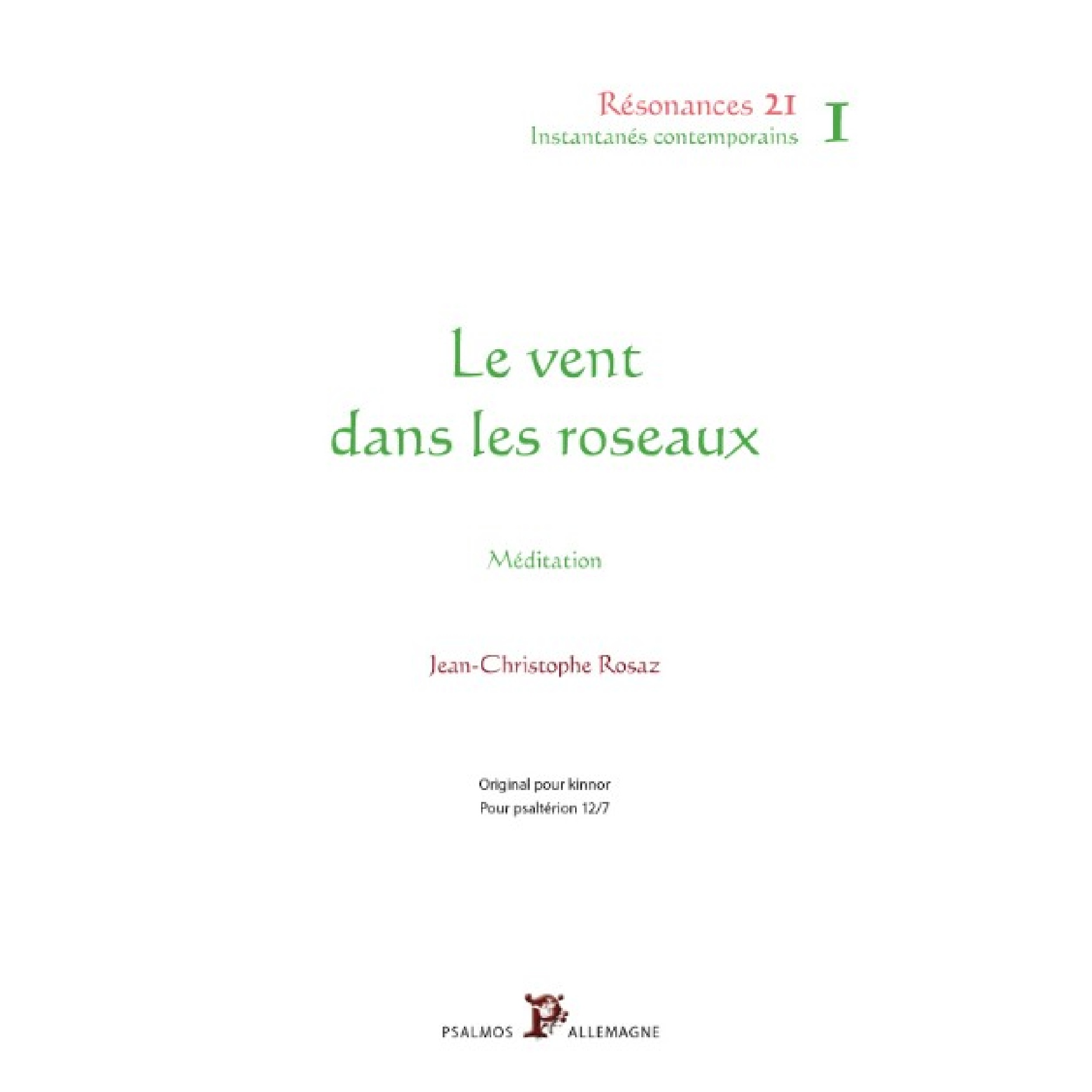
Le vent dans les roseaux – for psalterion or zither
A tribute to Frédéric Chopin
Dedicated to Brother Frédéric, monk of Cîtreaux abbay and friend
duration: around 4’30
published by Catherine Weidemann / Psalmos
order the score:
https://psalterion.info/index/partitions-pour-cithare/collections/#resonances
Description
Le moine cistercien doit son nom au roseau voisin, symbole de l’âme dans laquelle souffle le vent, c’est-à-dire l’Esprit. Si la main droite, à qui est confiée la mélodie, évoque notre être le plus profond, la main gauche, dont émane l’harmonie, est ce qui l’anime, surprenant parfois, toujours poussant de l’avant, vers un ailleurs. Dans cette pièce, écrite en souvenir des longues heures passées dans la crypte à écouter Frère Frédéric, ce musicien hors pair, j’ai souhaité explorer au mieux les ressources de la cithare, mais aussi sa capacité sans pareille à nous plonger dans la méditation. Jean-Christophe Rosaz
Avec un langage musical ouvert à des horizons très divers, Jean- Christophe Rosaz s’impose comme un compositeur curieux, éclectique et passionné. Créateur dans l’âme, il s’est formé auprès de grands musiciens contemporains, nourri par la richesse de leurs expériences et savoirs. Son propre langage se façonne au fil d’aventures artistiques et humaines multiples. Son œuvre, abondante et régulièrement interprétée, témoigne d’une créativité toujours en mouvement. Comment s’est-il intéressé à la cithare, instrument en marge des grandes institutions musicales ? Ce lien profond, presque intime, remonte à son enfance, lorsqu’il côtoyait Frère Frédéric de l’abbaye de Cîteaux, à qui Le Vent dans les roseaux est dédié. Musicien dans l’âme comme Jean-Christophe, Frère Frédéric travaillait ses instruments — piano, kinnor, psaltérion — sous l’église du monastère, dans sa petite crypte où il jouait et préparait la liturgie. Il y accueillait volontiers amis et amies, leur offrant quelques pages de musique, ou improvisant avec une lumineuse aisance. De ces souvenirs marquants, dans la petite crypte de Cîteaux, est née une œuvre pour kinnor, dédiée à Frère Frédéric. Le kinnor, qui n’a jamais connu un développement important, présente des accords majeurs et mineurs juxtaposés. Pour rendre la pièce jouable au psaltérion, le jeu des accords a été précisé, afin d’éviter les nombreux changements de modulateurs que la version originale pour kinnor aurait exigés. Le vent dans les roseaux peut désormais également rencontrer le public des psaltéristes. Catherine Weidemann
The Cistercian monk owes his name to the nearby reed, a symbol of the soul through which the wind blows, that is to say, the Spirit. If the right hand, entrusted with the melody, evokes our deepest self, the left hand, from which harmony emanates, is what animates it, sometimes surprising, always propelling us forward, toward something beyond. In this piece, written in memory of the long hours spent in the crypt listening to Brother Frédéric, this exceptional musician, I wanted to explore the resources of the zither as fully as possible, but also its unparalleled ability to immerse us in meditation. Jean-Christophe Rosaz
—
With a musical language open to diverse horizons, Jean-Christophe Rosaz has established himself as a curious, eclectic, and passionate composer. A creator at heart, he trained with great contemporary musicians, nourished by the richness of their experiences and knowledge. His own musical language has been shaped by a multitude of artistic and personal experiences. His abundant and regularly performed work testifies to a constantly evolving creativity.<
How did he become interested in the zither, an instrument on the fringes of major musical institutions? This deep, almost intimate connection dates back to his childhood, when he spent time with Brother Frédéric of the Cîteaux Abbey, to whom *Le Vent dans les roseaux* (The Wind in the Reeds) is dedicated. A musician at heart, like Jean-Christophe, Brother Frédéric practiced his instruments—piano, kinnor, psaltery—beneath the monastery church, in his small crypt where he played and prepared the liturgy. He readily welcomed friends there, offering them a few pages of music or improvising with luminous ease. From these poignant memories in the small crypt of Cîteaux, a work for kinnor was born, dedicated to Brother Frédéric. The kinnor, which never saw significant development, features juxtaposed major and minor chords. To make the piece playable on the psaltery, the chord progression has been clarified, thus avoiding the numerous modulator changes that the original kinnor version would have required. « The Wind in the Reeds » can now also reach psaltery players. Catherine Weidemann